
Aircraft-Ops
Unified operational tooling for aviation organizations.
What Is Aircraft-Ops?
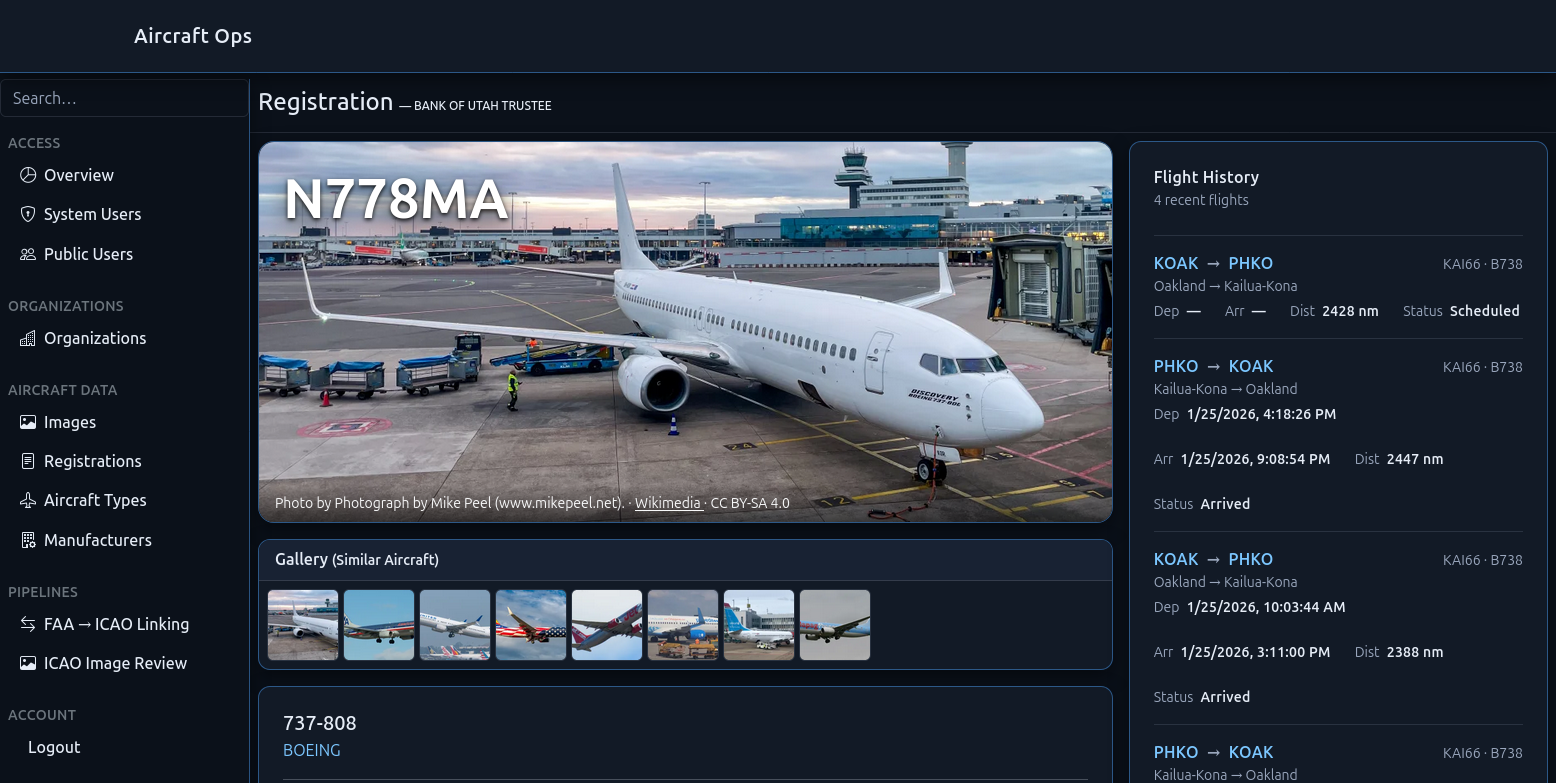
Aircraft-Ops is a multi-tenant aviation data platform for aggregating, normalizing, and serving structured aircraft information across registrations, images, operational metadata, and compliance logs.
It functions as a central system of record for aviation teams who need reliable, searchable aircraft data without maintaining fragmented internal tooling or manual workflows.
Who This Is For
FBO Operations
Track aircraft, registrations, and images across tenants with consistent identifiers and real-time search.
Maintenance Teams
Centralize aircraft metadata and future document ingestion for maintenance manuals, logs, and SOPs.
Compliance & Safety
Query immutable audit logs for operational actions, uploads, and system changes.
Core Workflows
Aircraft Search
- Search by tail number, manufacturer, or ICAO type
- View normalized registry records
- Cross-linked image gallery
Image Ingestion
- Presigned uploads
- Automatic validation and moderation
- ML-based cropping and classification
Operational Logging
- Every action emits structured audit events
- Filter by user, org, or event type
- Time-bucketed analytics
Multi-Tenant Access
- Subdomain-based org routing
- Role-based permissions
- Isolated datasets per tenant
Platform Capabilities
Normalized Data Models
All entities share deterministic schemas and identifiers across registries, images, and logs.
Search & Indexing
Full-text search, faceting, and autocomplete across all aircraft records.
Event Pipelines
All ingestion, processing, and indexing runs asynchronously through background workers.
Audit & Observability
Immutable audit trail for all system actions with queryable historical logs.
Scalable by Design
Serverless architecture with no fixed capacity limits or blocking services.
Planned: Organizational Knowledge Layer
AircraftOps is architected to support semantic retrieval over internal organizational knowledge: company memos, SOPs, manuals, schedules, operational logs, and domain-specific records.
The current platform already provides the domain entity graph, document vault, event model, and access-control layer. The knowledge layer is a planned extension built on top of this foundation.